A few years back, my father met with an accident. He slipped in our backyard where we had vibration woods stored on a slope, and fell on his head. There was no external wound and no bleeding, so we didn’t think much of it at the time. But the injury was actually inside, and we had no idea.
Slowly, we started noticing changes in his behaviour. His speech became slurred, saliva would come out of his mouth while talking, he stopped eating properly, and he couldn’t sleep at night. He began losing weight, and his condition kept getting worse. By the time almost a month had passed, he couldn’t even walk — he just lay down all the time. That’s when we decided it was time to take him to a hospital.
The Local Hospital and the MRI That Changed Everything
We first went to a nearby local clinic and got him admitted. The doctors gave him IV drips and some medications, but there was no real improvement. So they suggested an MRI scan. Around this time, he had also started forgetting people we knew — that was the moment we truly panicked.
The next day, the scan report came back. The doctor said there was a possibility of brain cancer, and it looked like there was a blood leak in his head — though nothing was confirmed. He told us plainly: if we wanted to take him to a bigger hospital, we should go now, because anything could happen to him at any time.
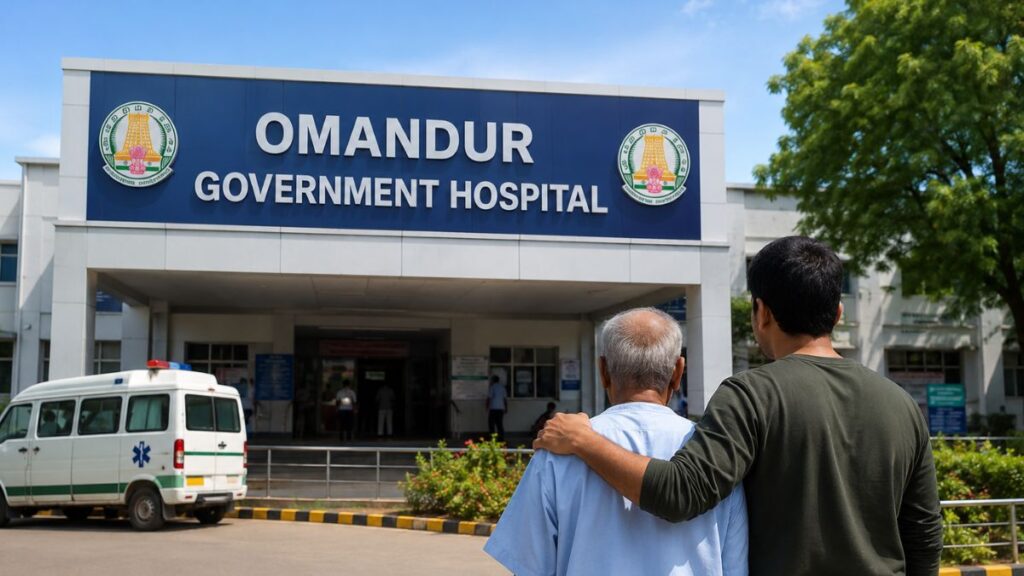
That line stayed with me. I immediately started searching online for good neuro hospitals in Chennai. That’s when I found Omandur Multi Speciality Hospital and confirmed they handle neuro treatments. Around the same time, my cousin called and mentioned he personally knew a senior doctor in their neuro department. I didn’t waste a single minute — I booked an ambulance right away.
The 350 KM Journey from Nagapattinam to Chennai
We travelled from Nagapattinam to Chennai, a distance of around 350 km, and the ambulance cost us close to ₹14,000. We reached Omandur Multi Speciality Hospital at 7 AM and got him admitted straight into the emergency ward.
The doctors checked his previous medical reports, gave him essential medicines, and said they would analyse his case before shifting him to the right department. After about an hour, he was moved to the oncology department. At that point he could still speak and respond to us, so we waited for the doctor.
The oncology doctor reviewed the scan and asked us to consult another oncology specialist. We waited in queue again, and this second doctor also couldn’t reach a clear conclusion on whether it was cancer or a neuro issue. They needed to confirm the exact cause before admitting him to the correct department — which meant more waiting, more uncertainty.
Almost Referred to a Different Hospital
We were then asked to go back to the neuro department. We waited about 30 minutes, and once we got into the doctor’s cabin, we learned that the specific doctor my cousin knew was on leave that day. The duty doctor reviewed the report and actually suggested we take him to Rajiv Gandhi Government Hospital instead.
I got nervous — I hadn’t even mentioned the referral yet. I quickly called my cousin and explained the situation. He called the doctor directly, spoke to the team, and arranged for my father’s admission to the neuro ward. The duty doctors then completed the admission process and moved him into the ICU.
The entire process — from reaching the hospital to actually getting him admitted — took a full day.
ICU, Daily Tests, and the First Signs of Recovery
Once admitted, the doctors gave him frequent medication and ordered multiple lab tests to assess his condition. The lab is on the ground floor, and testing is completely free — you just drop off the samples at the counter, and they tell you when the reports will be ready.
After 3–4 days, we started seeing real improvement. He could speak clearly again and walk properly. The hospital food for ICU patients was genuinely healthy — banana, spinach, other vegetables, root vegetables, and soup. Every morning at 5 AM, attenders had to wake the patient up for brushing, face wash, and general freshening up, since doctors did their rounds by 6 AM.
After more scans, the doctors finally concluded it wasn’t cancer — it was a blood clot. He was shifted from ICU to the neuro surgery ward, a regular ward with far fewer restrictions and food service included.
Choosing Medicine Over Surgery
A week later, after more scans to check the clot level, the doctors said surgery was needed to remove it. But given my father’s age (65+), we were worried about the risks of a head operation, so we declined surgery. The doctors then prescribed medication instead and discharged him, asking us to come back after 10 days.
That decision turned out to be the right one. Once home, he took his medicines and food properly and started recovering well. On our follow-up visit, a new scan showed the blood clot had reduced by 90% — entirely through medication, no surgery. The doctors extended the medicine course for another month. My father made a full recovery without ever going under the knife.
What I Learned as a Patient Attender at Omandur Hospital
A few practical things I picked up from spending days there as an attender:
- ICU calls: Nurses can call an attender at any time — even midnight or early morning — if they notice any change in the patient’s monitor readings.
- Attender rooms: Most ICU wards have 1–2 small rooms nearby for attenders, with mobile charging points, a separate toilet/bathroom, and RO water.
- Cleanliness: The floors are well maintained by housekeeping staff. Many attenders sleep on the floor at night — we never had mosquito problems, but do check the floor for bedbugs in some spots.
- Attender card: You’ll be given an attender card — keep it safe, you’ll need it.
- Food and essentials: There’s a canteen on the second floor, plus a small hotel and an ATM inside the hospital campus. An Aavin tea stall is available underground too.
- Timing rules: After 10 PM, security usually doesn’t allow attenders back in — they may make exceptions if you explain, but it’s better to finish dinner and other errands before 10 PM.
- Lifts: Plenty of lifts in the building, though they do get crowded during peak hours.
- Parking: Spacious — no trouble parking a car or bike.
- Connectivity: Well connected — Government Estate metro station is nearby, along with the D10 police station bus stop, and auto/cab availability right outside.
If you want to travel by metro train, check our metro train timings post for more details
What to Carry If You’re Getting Treatment Here
- Patient’s Aadhar card
- CM Health Insurance card (if applicable)
- Previous medical reports, especially if referred for surgery by another doctor
If it’s a surgery referral case, they may also ask for the CM insurance card along with Aadhar at the time of admission.
Omandur Multi Speciality Hospital handles a wide range of specialities — oncology, vascular, neuro, cardiology, ortho, nephrology, and more. Cardiology in particular sees heavy daily footfall. For emergencies, head straight to the emergency ward. For non-emergency visits, you’ll need to get an OP card before consulting a doctor.
This post is based on our personal experience accompanying a family member through treatment. It’s meant to help other patients and attenders know what to expect — not as medical advice. Please consult your doctor for anything related to diagnosis or treatment.